Mobasher
Systemanchorage & nailing
StatusCompleted
Scale27m
Date2014
LocationTehran ; Elahiye
The Elahieh Excavation Stabilization Project
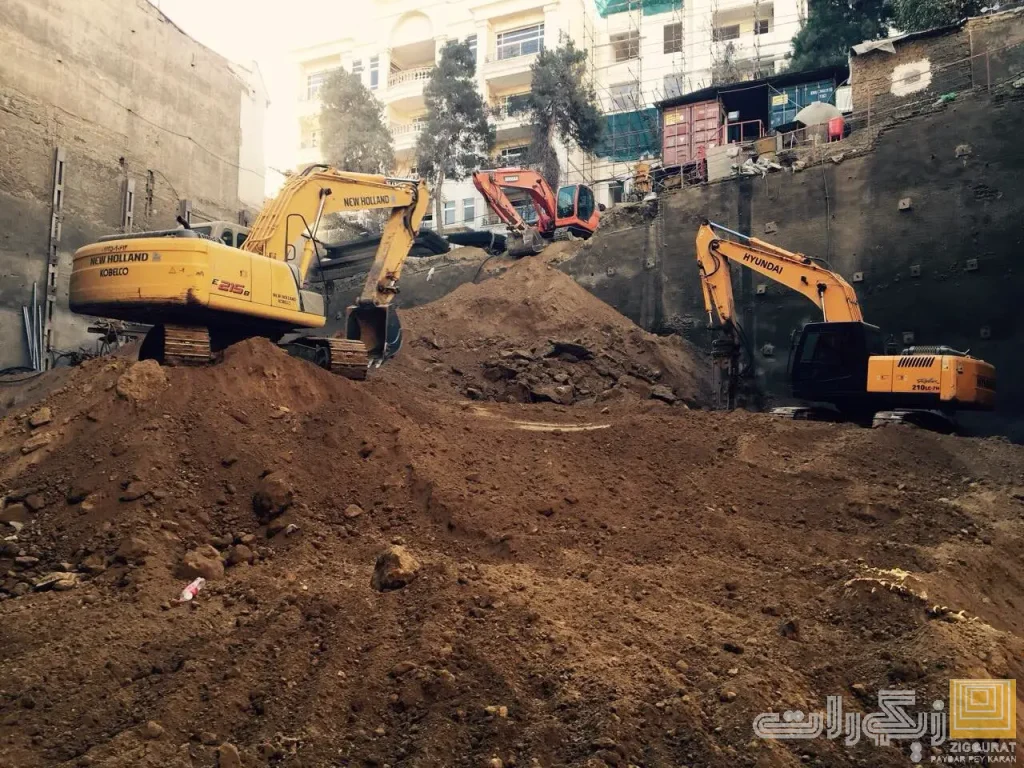
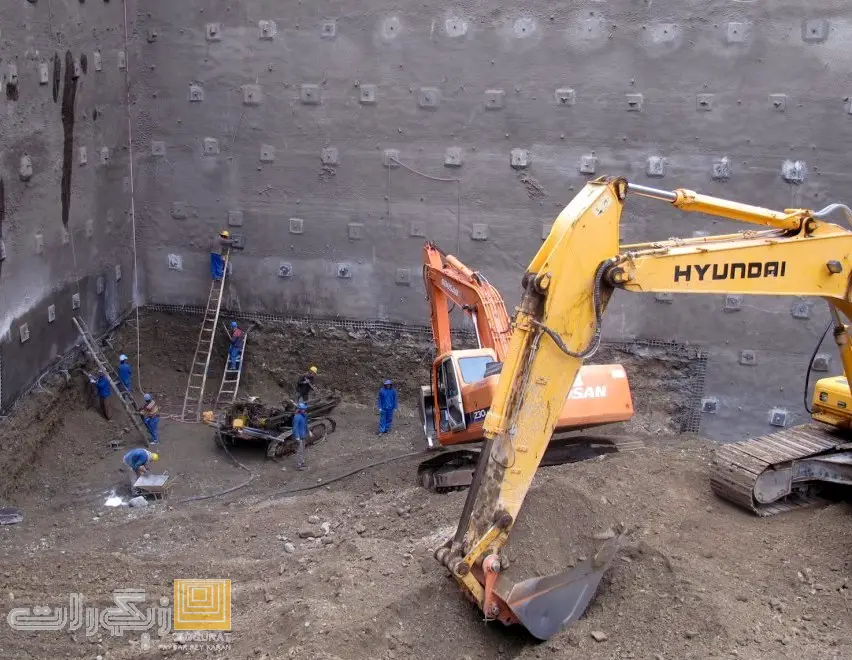
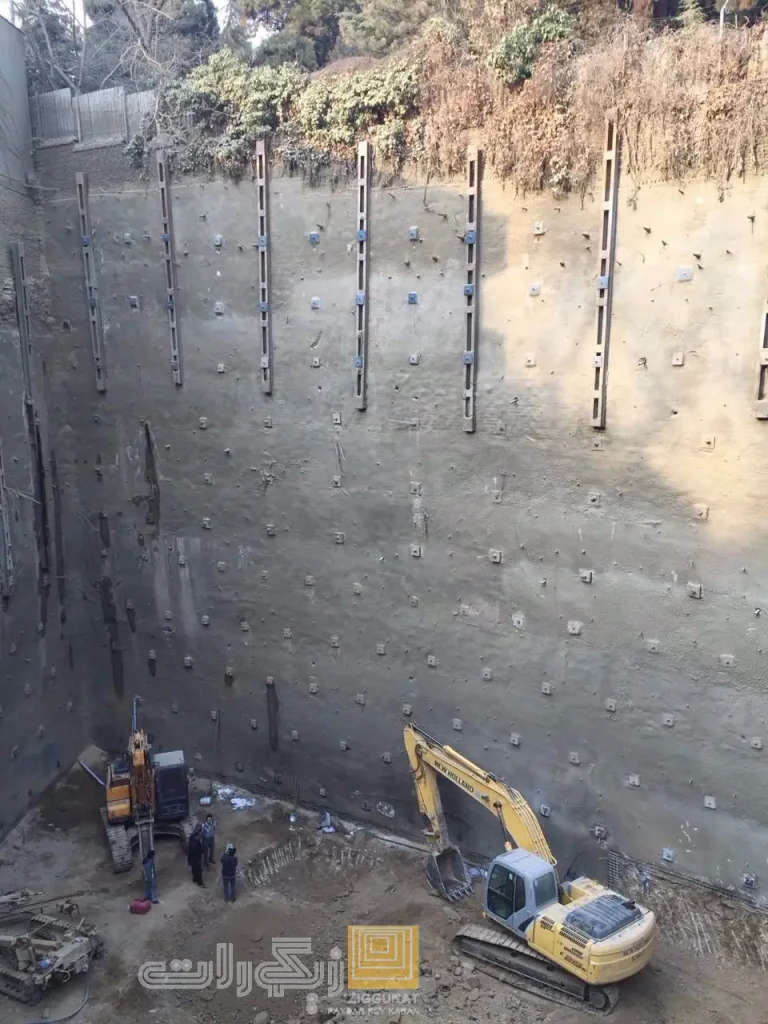
The Elahieh excavation stabilization project was one of the specialized projects undertaken by the Ziggurat technical team in the Elahieh district of Tehran. The excavation reached a depth of 27 meters under challenging site conditions, where the soil profile consisted of water-bearing clay and an old existing building was located directly along the eastern side of the excavation. These two factors made the project one of the most sensitive excavation stabilization projects recently undertaken by the technical team.
Geotechnical Challenges of the Elahieh Excavation Stabilization Project: Saturated Clay and an Adjacent Building
In deep excavations, water-bearing clay is consistently one of the primary concerns for geotechnical engineers. An increase in pore-water pressure within saturated clay can reduce the available shear strength of the soil and increase the potential for lateral deformation of the excavation walls.
At the same time, the presence of an old building along the eastern side of the excavation significantly restricted the design and construction options available to the project team. Any excessive movement of the eastern excavation wall beyond the allowable limits could have directly affected the foundation of the adjacent building. Therefore, the selected stabilization system had to satisfy two critical objectives simultaneously: maintaining excavation stability and protecting the structural integrity of the adjacent building.
Such site conditions can also have a direct impact on the cost and construction schedule of excavation stabilization projects.
Excavation Stabilization Method: nailing and Anchoring at a Depth of 27 Meters
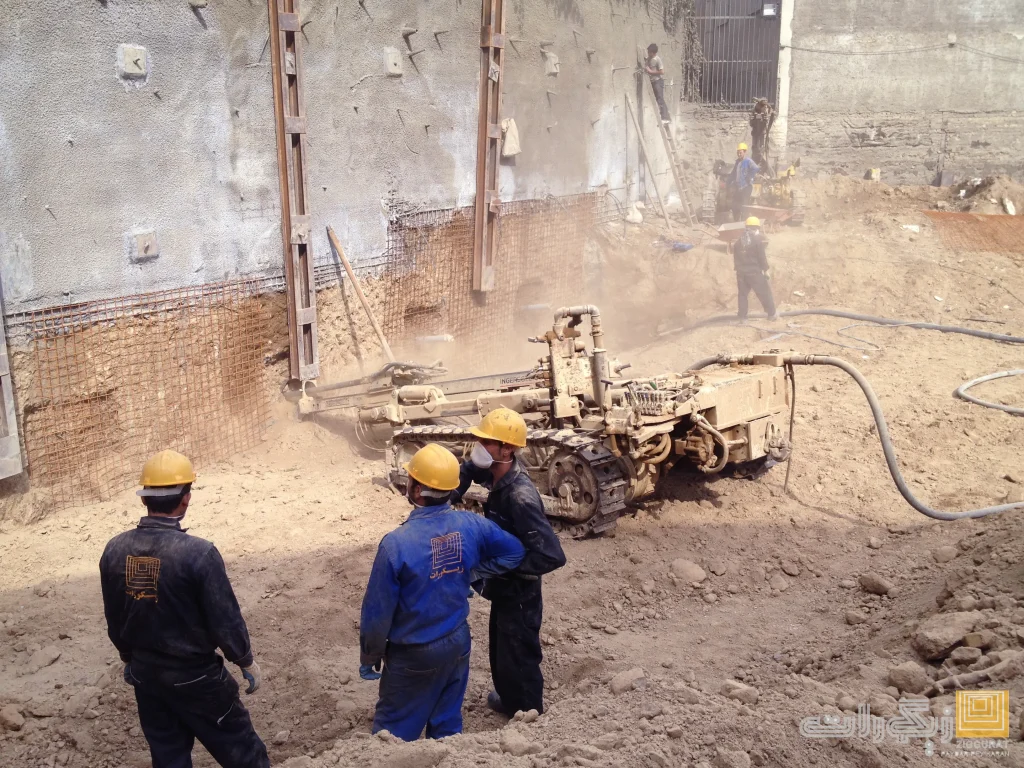
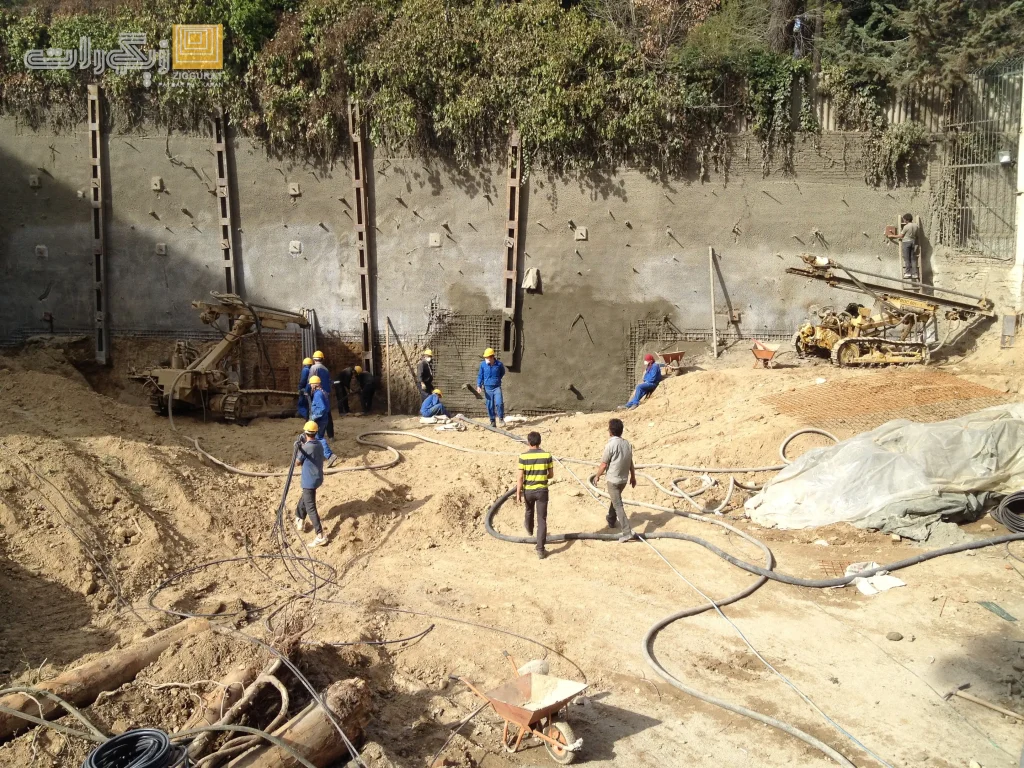
For this project, a combination of nailing and ground anchoring was selected as the excavation retaining system. The piles served as the primary structural elements supporting the excavation walls, while the ground anchors transferred tensile forces into more competent soil layers, providing the required lateral stability at the 27-meter excavation depth.
The selection of ground anchors was based on the need for an active stabilization system. Anchored systems are capable of applying stabilizing forces before significant wall movement occurs, whereas passive systems such as soil nails primarily mobilize their capacity through deformation of the surrounding ground.
Throughout the construction process, excavation-wall deformations were continuously monitored using instrumentation. This enabled the technical team to identify any approach toward the allowable deformation limits and implement corrective measures in a timely manner.
Settlement Control and Protection of the Adjacent Existing Building
One of the most critical performance criteria for this project was maintaining excavation-wall and adjacent-building deformations within strict allowable limits. Through detailed staging and design of the anchoring system, appropriate selection of the anchor free and bonded lengths, and continuous monitoring throughout construction, the final deformation was limited to less than one centimeter.
In addition to the nailing and anchoring systems, a comprehensive monitoring program for excavation and building settlement and displacement was established from the early stages of construction. Measurements obtained from reference points were continuously compared with the allowable design values, enabling any deviation from the initial predictions to be identified and addressed at an early stage.
This continuous monitoring approach ultimately made it possible to maintain the deformation of the adjacent building at less than one centimeter.
Achieving such a limited deformation in a 27-meter-deep excavation in saturated clay demonstrates the high level of precision achieved in the design and construction processes, particularly given the requirement to protect an existing older building that lacked a modern, high-capacity foundation system.
Why Is Selecting the Appropriate Excavation Stabilization Method Important?
In urban excavation projects, the limited distance between deep excavations and adjacent structures, combined with the presence of water-bearing or saturated clay, leaves very little margin for error. An inappropriate selection between piling, ground anchoring, and soil nailing can result in excessive ground and wall deformation, cracking or damage to adjacent structures, and, in severe cases, disruption or suspension of construction activities.
The experience gained from this project demonstrated that the combined use of nailing and ground anchoring can effectively provide both excavation stability at a depth of 27 meters and protection of adjacent structures under challenging conditions involving saturated clay and an existing building in close proximity to the excavation.
Conclusion: Elahieh Excavation Stabilization Project
The Elahieh excavation stabilization project represents a successful application of a combined nailing and ground anchoring system for a 27-meter-deep excavation in saturated clay, immediately adjacent to an existing older building. Limiting the final deformation to less than one centimeter was the direct result of the appropriate selection of the stabilization method, detailed design of the anchoring system, and continuous monitoring and technical supervision by the Ziggurat team.
For similar deep excavation stabilization projects, the Ziggurat team continues to apply a combined stabilization approach supported by continuous instrumentation and performance monitoring, with the objective of maintaining excavation stability while minimizing deformation and protecting adjacent structures.