Dey Hospital Expansion Project
SystemStrand, Anchor, Piles
StatusCompleted
Scale20m
Date2015
LocationTavanir, Tehran
Dey Hospital Excavation Stabilization: Project Overview
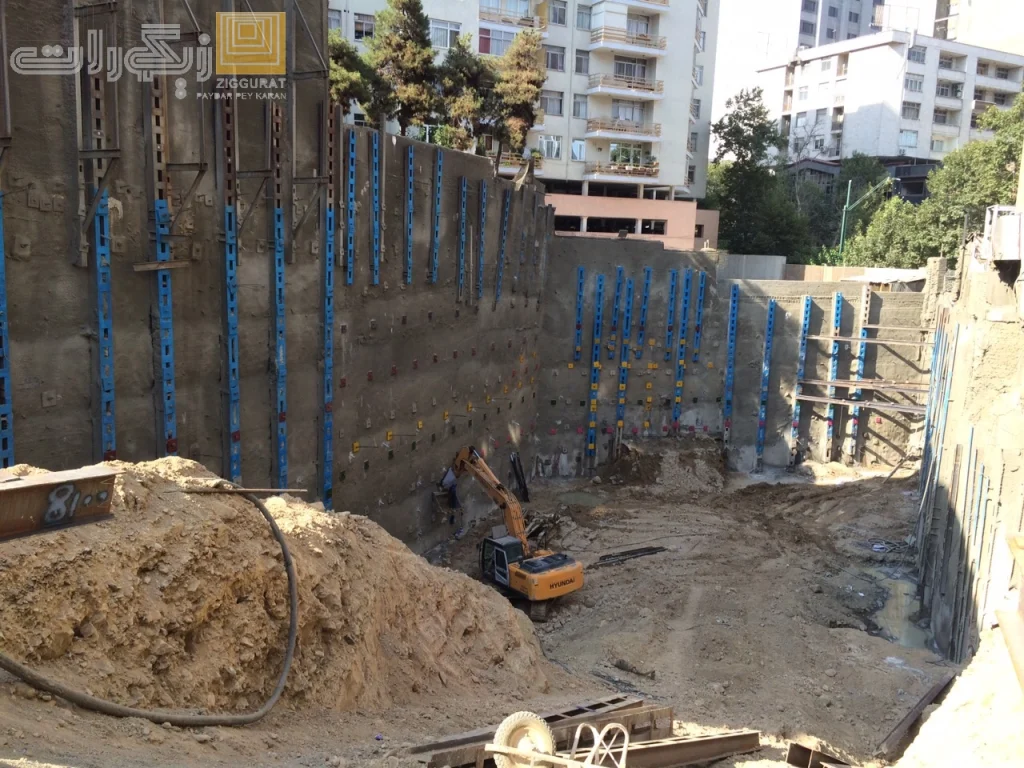
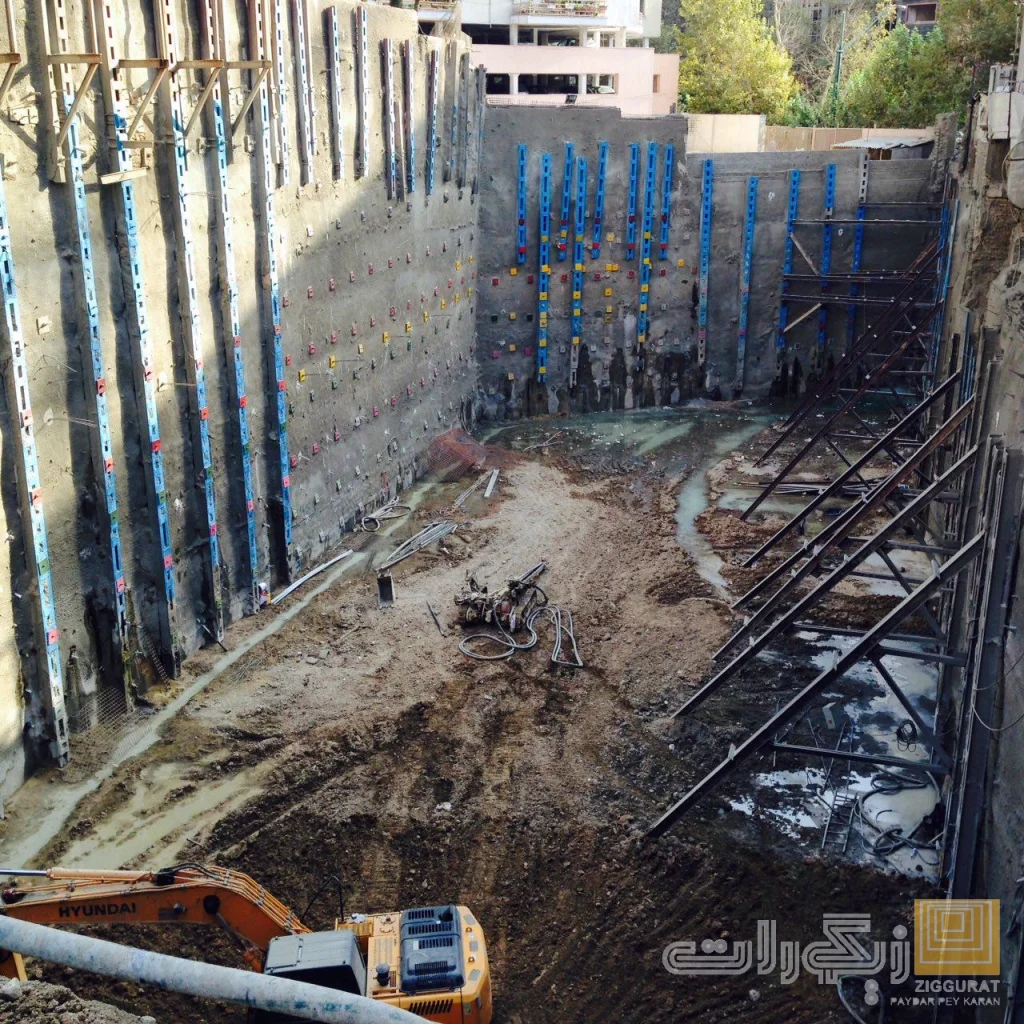
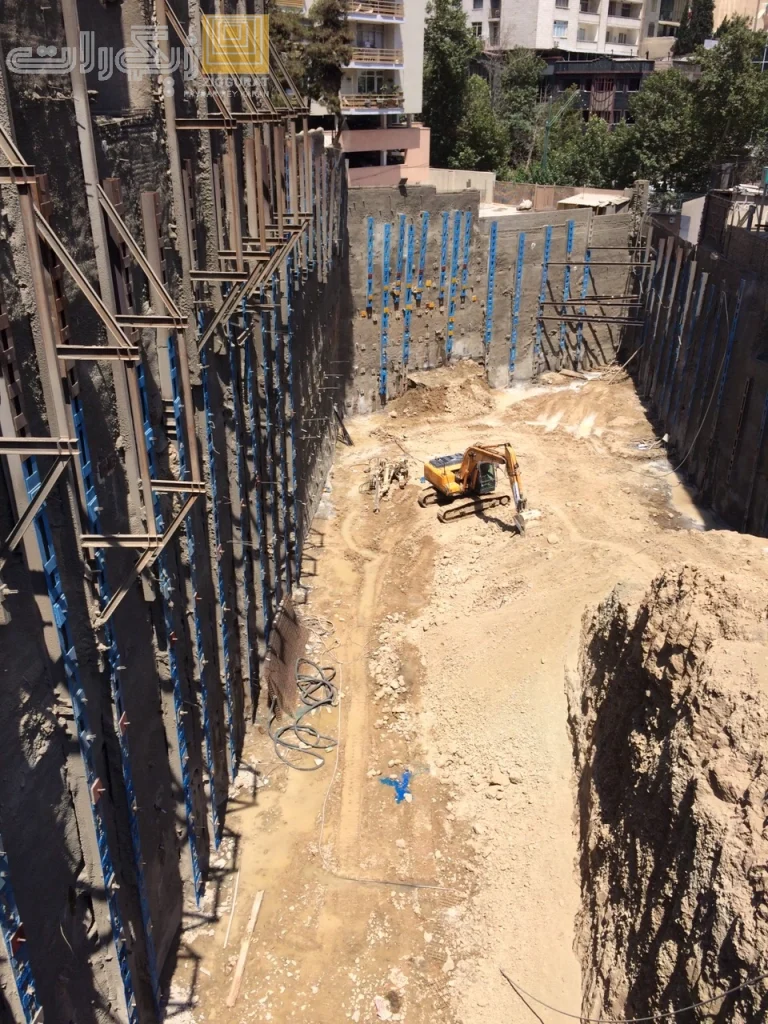
The Dey Hospital excavation stabilization project stands among Ziggurat’s most sensitive urban assignments. The pit reached a depth of 20 meters within Tehran’s dense urban fabric, with serious neighboring constraints on both project fronts — conditions that shaped every design decision from day one.
A Stepped Foundation with Near-Zero Execution Margin
The Dey Hospital building itself sat on a stepped pile foundation. In some sections, only one meter of soil separated the excavation wall from the pile shafts. This effectively reduced the execution error margin to zero: any localized wall settlement could have threatened a functioning treatment center still in daily operation.
The North Side: Old, Fragile Neighboring Structures
On the northern boundary, very old buildings with deteriorated skeleton-and-foundation systems stood directly adjacent to the pit. Their sensitivity to settlement and small deformations demanded a more conservative design approach, along with strict displacement-control monitoring throughout construction.
High Groundwater: The Third Layer of Complexity
A high groundwater table near the pit elevation added a third dimension of difficulty. Water presence at the excavation level affected both long-term wall stability and short-term execution conditions during every stage of work.
Engineering Solution: PLAXIS Numerical Analysis and Combined Stabilization
for Dey Hospital excavation stabilization Ziggurat’s technical team ran numerical wall analysis in PLAXIS software, designing each section of the excavation separately to match its unique conditions. The combined stabilization system included:
• Multi-strand anchored
nailing
and soil nailing
• A staged (stepped) pile wall
• A dedicated dewatering and groundwater-control system
• Continuous displacement monitoring of the wall and neighboring buildings through the SNR monitoring system
Dey Hospital excavation stabilization project Outcome
The result was a safely delivered excavation with zero damage or disruption to hospital operations and the surrounding residential buildings — a benchmark example of deep excavation stabilization in high-risk urban environments.
Why This Project Matters for Hospital and Healthcare Construction
Excavating next to an operating hospital is not an ordinary urban construction challenge. A medical facility cannot tolerate downtime, vibration risk, or structural uncertainty the way a typical commercial site might. Every stage of the Dey Hospital excavation stabilization work had to be planned around one constraint that overrode all others: the hospital had to keep functioning, without interruption, for the entire duration of the project.
This is why the combined stabilization strategy mattered so much here. Rather than applying a single generic shoring method across the whole perimeter, Ziggurat’s technical office treated each side of the pit as its own engineering problem — matching the anchoring, nailing, and
pile-wall design
to the specific soil, groundwater, and adjacent-structure conditions found there. The staged pile wall absorbed the tight margin left by the hospital’s own stepped foundation, while the northern anchoring and nailing system was tuned conservatively to protect the fragile old buildings nearby.
Continuous monitoring through the SNR system turned this from a one-time design decision into an ongoing safety process: displacement data from the wall and the neighboring structures was tracked throughout construction, allowing the team to catch and correct any deviation before it became a risk. This kind of real-time, data-driven excavation stabilization is increasingly the standard Ziggurat applies to sensitive urban sites — hospitals, schools, and dense residential blocks — where the cost of an error is measured not just in money, but in disruption to people’s lives.
The successful, damage-free handover of the Dey Hospital excavation stabilization pit is a practical demonstration of what deep excavation stabilization looks like when it’s engineered specifically for high-risk, high-consequence urban environments — not adapted from a standard template.